

Standing in the storage aisle staring at shoe racks, plastic bins, and tall armoires can feel overwhelming, especially when any of the three could technically solve your clutter problem. The truth is that each option serves a different purpose, fits a different space, and suits a different lifestyle. Choosing the wrong one means either wasted money or a mess that creeps right back within a few weeks. This guide breaks down exactly how to decide between a shoe rack, a storage bin, and an armoire based on your space, budget, household size, and long-term needs, so you only have to make this decision once.
Start With the Question: What Are You Actually Storing?
Before comparing furniture types, get specific about what needs a home. “Shoes” is not one category. Are you storing five pairs of everyday sneakers, or twenty pairs across seasons including boots, sandals, and formal shoes? Are you also trying to corral scarves, hats, umbrellas, and gloves? Or are you dealing with bulkier seasonal items like winter coats, extra bedding, or holiday decorations that need to disappear for months at a time?
A shoe rack is built for one job: keeping footwear visible, accessible, and off the floor. A storage bin is a flexible container built for anything that does not need daily access. An armoire is a freestanding wardrobe-style cabinet meant to house a mix of hanging items, folded clothes, shoes, and accessories in one enclosed piece of furniture. Matching the item to the container is the first and most important filter.
Shoe Racks: Best for Daily Rotation and Visibility
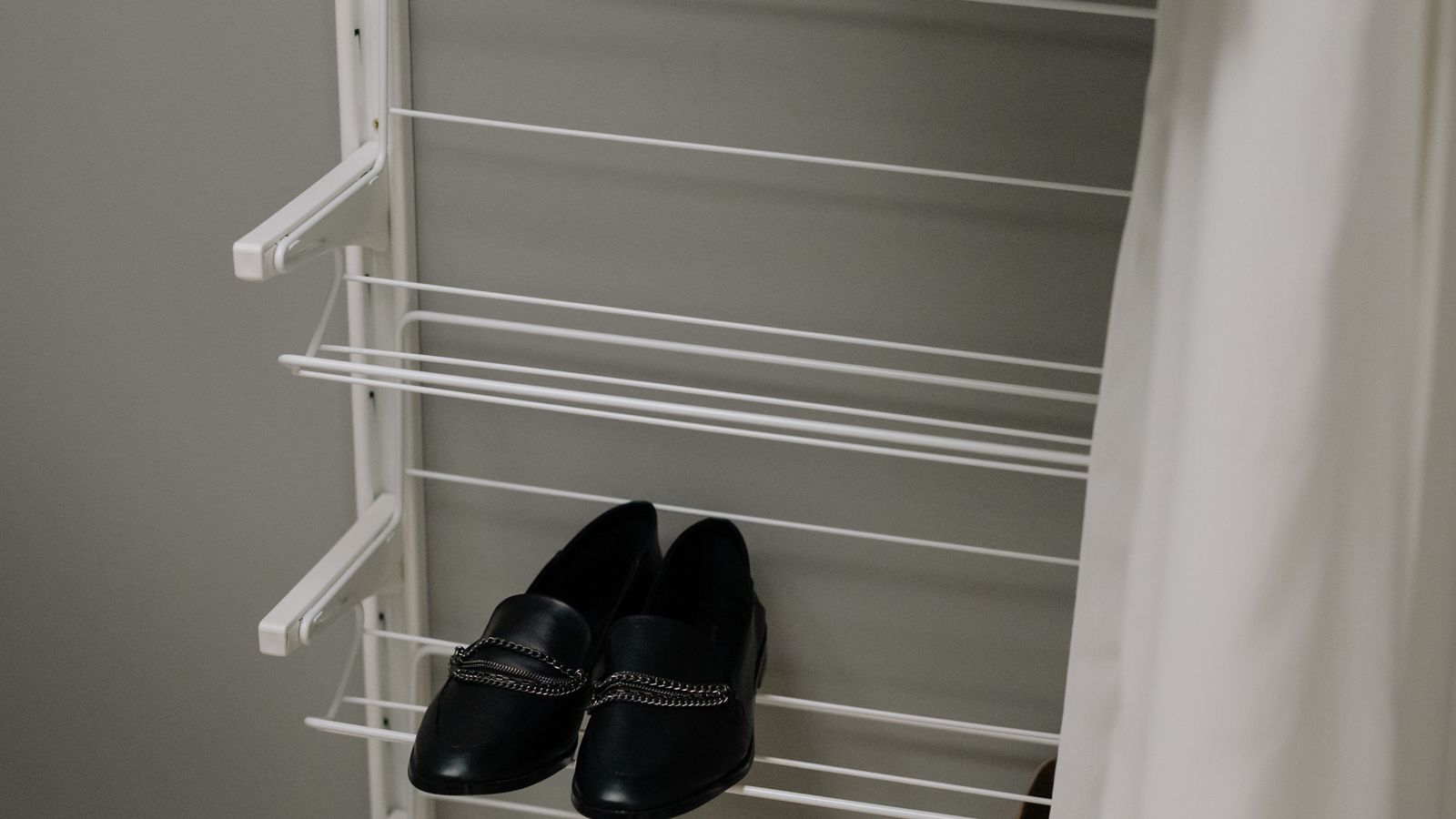
Shoe racks exist for one reason: to make grabbing the right pair fast and effortless. If you or your family members are constantly in and out the door, a rack near the entryway keeps shoes from piling up on the floor, on stairs, or by the couch. Most racks use open shelving or angled slats so every pair is visible at a glance, which matters if you own more than a handful of styles.
Shoe racks are usually the most affordable of the three options and take up the least floor space relative to how many pairs they hold. A narrow five-tier rack can fit twenty or more pairs in under two square feet of footprint. The tradeoff is that shoes stay exposed to dust and light, and a rack does nothing for coats, bags, or accessories.
Choose a shoe rack if:
- You need quick, everyday access to footwear near a door or closet entrance.
- Your household owns fewer than 20-25 pairs total.
- Floor space is tight and you want a slim, vertical footprint.
- You want an affordable fix you can set up in minutes with no assembly headaches.
Browse a range of styles, from stackable cube racks to over-the-door versions, in our guide to the Shoe Racks currently worth buying.
Storage Bins: Best for Out-of-Season and Infrequently Used Items
Storage bins solve a completely different problem than shoe racks. Instead of daily access, bins are about protecting and hiding items you only need a few times a year: winter boots in summer, holiday linens, out-of-season clothing, or spare bedding. Stackable plastic bins with lids seal out dust, moisture, and pests, which matters if you are storing items in a garage, attic, or basement rather than a climate-controlled closet.
Bins are also the most flexible option in terms of placement. They stack under beds, on closet shelves, in garages, or in a spare room, and they cost very little per unit compared to furniture. The downside is visibility and access: you often have to dig through several bins to find what you need, and stacked bins are not something you want to open multiple times a day.

Choose storage bins if:
- You are storing seasonal or rarely used items rather than daily essentials.
- You need protection from dust, moisture, or pests in a garage, attic, or basement.
- You want the lowest cost per unit of storage capacity.
- You need something stackable and easy to relocate if you move often.
See top-rated stackable and clear-view options in our roundup of the best storage bins.
Armoires: Best for Consolidated, Multi-Category Storage
An armoire is the most substantial of the three, and it is designed to replace a small closet rather than supplement one. A single armoire typically combines a hanging rod, folded-clothes shelves, and sometimes a shoe cubby or drawer, all behind closed doors. This makes it the right choice for bedrooms without a built-in closet, guest rooms, studio apartments, or anyone who wants clothing, shoes, and accessories consolidated into one enclosed piece rather than scattered across multiple small organizers.
Armoires cost significantly more than a rack or a set of bins, and they require real floor space and often two people to assemble and move. But they deliver something the other two cannot: a single furniture piece that looks intentional in a bedroom or living space while hiding clutter completely behind closed doors. If you have been layering a shoe rack, a garment rack, and a stack of bins in the corner of a room, an armoire can often replace all three with one cohesive unit.
Choose an armoire if:
- You lack a built-in closet or need to supplement a small one.
- You want hanging clothes, folded items, and shoes stored together in one place.
- Appearance matters and you want storage that looks like furniture, not utility shelving.
- You have the floor space and budget for a larger investment piece.
Compare freestanding styles and finishes in our guide to the best armoires.
Side-by-Side Comparison
Here is how the three options stack up across the factors that matter most when making this decision:
- Access frequency: Shoe rack (daily) > Armoire (daily to weekly) > Storage bin (seasonal/occasional).
- Footprint: Shoe rack (small, vertical) < Storage bin (variable, stackable) < Armoire (large, fixed).
- Cost: Storage bin (lowest per unit) < Shoe rack (moderate) < Armoire (highest upfront).
- Protection from dust/pests: Storage bin (best, sealed) > Armoire (good, enclosed) > Shoe rack (minimal, open).
- Versatility of contents: Armoire (clothes, shoes, accessories) > Storage bin (almost anything) > Shoe rack (footwear only).
- Assembly effort: Storage bin (none) < Shoe rack (light) < Armoire (moderate to heavy).
Budget: How Much Should You Actually Spend?
Budget is often the deciding factor once function is settled. A basic shoe rack typically costs the least of any dedicated furniture solution, making it an easy first purchase if you are just trying to stop shoes from piling up by the door. Storage bins are sold individually or in multi-packs and are the cheapest way to add capacity fast, especially if you need to store a large volume of seasonal items across several containers.
Armoires represent a bigger investment because you are paying for construction, finish, and the equivalent of a small built-in closet. If your budget is limited, a smart approach is to start with a shoe rack and a few bins to handle immediate clutter, then save toward an armoire if you determine your space genuinely lacks adequate closet storage. Buying an armoire before confirming you actually need that much consolidated storage is the most common expensive mistake in this category.
Space Planning: Where Will It Actually Fit?
Measure before you shop, regardless of which option you lean toward. For a shoe rack, measure the width available near your entry point and check ceiling clearance if you are considering a tall, multi-tier unit. For bins, measure shelf depth and height in the closet, garage, or under-bed space where they will live, and confirm the stack height will not block a door or light fixture.
Armoires require the most careful planning: measure not just the footprint but the door-swing clearance, and double-check the piece will fit through doorways and stairwells before it arrives. Also consider room flow. An armoire that blocks a walking path or crowds a window will feel oversized no matter how well it organizes your belongings, while a shoe rack or bin can usually be relocated or resized without much consequence.
Can You Combine All Three?
In most real households, the best solution is not choosing just one but layering all three based on function. A shoe rack near the entry handles daily footwear rotation. Storage bins on a closet shelf or in the garage handle seasonal rotation, holiday items, and overflow. An armoire, if you have the space and budget, becomes the anchor piece that houses everyday clothing and accessories in a bedroom without a built-in closet. Thinking of these as complementary tools rather than competing options usually produces the most livable result.
If you are also organizing a broader closet space, pairing any of these with closet organizers or a modular closet system can tie everything together, especially in bedrooms where an armoire supplements rather than replaces existing closet space.

A Quick Decision Checklist
Still unsure? Run through these questions:
- Do I need this item every day? If yes, lean toward a shoe rack or armoire, not a bin.
- Am I storing more than one category of item (clothes, shoes, accessories)? If yes, an armoire is likely the most efficient single solution.
- Is my main goal protecting items from dust or pests during long-term storage? If yes, bins win.
- Is floor space extremely limited? A slim shoe rack or stackable bins will beat a bulky armoire.
- Is budget the primary constraint right now? Start with bins and a rack, and revisit an armoire later.
Common Mistakes to Avoid
The most frequent misstep is buying an armoire for a problem a shoe rack could have solved for a fraction of the cost, simply because it looked like the “complete” solution in a showroom. The second most common mistake is relying on open bins or an open rack for items that actually need dust and pest protection, leading to musty, dusty seasonal storage. Finally, skipping measurements before ordering an armoire is a costly error, since large furniture returns are expensive and inconvenient. Take ten minutes to measure and plan before you commit to any of the three.
FAQ
Do I need a shoe rack if I already have an armoire with a shoe cubby?
Not necessarily, but many armoire shoe cubbies only hold a handful of pairs. If your household owns more shoes than that, a dedicated rack near the entry for daily-use pairs, paired with the armoire for the rest, works better than forcing everything into one cubby.
Are storage bins safe for long-term clothing storage?
Yes, especially clear, airtight bins, which protect fabric from moisture and pests better than open shelving. Just make sure clothing is clean and completely dry before sealing it away, since trapped moisture can lead to mildew.
Is an armoire worth it if I already have a small closet?
It depends on how full your existing closet already is. If you are consistently running out of hanging space or floor space for shoes, an armoire can meaningfully expand your capacity. If your closet is only lightly used, bins and a rack are usually enough.
What’s the most space-efficient option for a small apartment?
A slim shoe rack combined with stackable bins typically wins in small apartments, since both can be tucked into corners, closets, or under furniture. An armoire only makes sense in a small space if there is no closet at all.
Final Thoughts
There is no single “best” choice among a shoe rack, a storage bin, and an armoire, because each is built to solve a different storage problem. Match the container to what you are actually storing and how often you need to access it: daily footwear calls for a rack, seasonal and infrequent items call for bins, and consolidated, multi-category storage in a room without a closet calls for an armoire. Most households end up using a combination of all three, and that is a perfectly reasonable outcome. Start with the option that solves your most urgent clutter problem today, and add the others as your space and budget allow.