

Choosing a high-resolution display with true-to-life tones makes a noticeable difference for creative workflows and immersive entertainment. Many shoppers struggle to find displays that balance high pixel density with dependable hue precision, often ending up with panels that oversaturate skin tones or crush subtle shadows. Our breakdown of the 3 options for the Best 1440p Monitors Color in September 2026 highlights top solutions across respected brands like Acer, ASUS, Samsung.
Modern QHD panels have advanced rapidly, offering wider color spaces and refined factory calibrations at accessible price points. If you are upgrading your workstation layout, you can consult our How To workspace setup resources to optimize your physical desk environment. This guide eliminates the guesswork by breaking down gamut metrics, panel technologies, and calibration nuances so you can select the right screen with confidence.


Panel Technology and Viewing Angle Consistency
Panel architecture serves as the fundamental foundation for all color reproduction and image stability. In-Plane Switching (IPS) panels remain the industry benchmark for color consistency across wide viewing angles. When you move off-axis on an IPS display, hues stay remarkably stable without shifting toward yellow or washing out entirely.
Vertical Alignment (VA) panels offer deeper native black levels, which can enhance contrast in dark environments. However, VA panels frequently suffer from gamma shifting and minor color degradation when viewed from slight angles. For creative tasks where edge-to-edge hue consistency across a 27-inch canvas is essential, IPS technology provides superior tonal fidelity.
When comparing specifications, always verify the stated horizontal and vertical viewing angles, which should ideally be 178 degrees. A dependable rule of thumb is to prioritize IPS panels if photo editing, illustration, or design work forms any part of your daily routine. This simple check ensures your canvas remains uniform from corner to corner.
Color Gamut Coverage and Standard Profiles
Color gamut describes the complete range of shades that a screen can physically reproduce. The standard sRGB profile covers most internet content, web graphics, and everyday productivity applications. A display delivering 99 percent or 100 percent sRGB coverage ensures web graphics and general media appear exactly as the creators intended.
Wider color spaces like DCI-P3 and Adobe RGB provide richer greens, deeper reds, and extended tonal ranges needed for cinema mastering and print preparation. Displays supporting 95 percent DCI-P3 coverage deliver vivid, cinematic tones that enrich both digital content creation and high-fidelity video playback. Without a dedicated wide-gamut profile, saturated hues can occasionally appear clipped or overly intense.
Look for hardware that includes dedicated color profile modes directly in the on-screen display menu. This allows you to toggle between a restricted sRGB mode for web browsing and a wide-gamut mode for digital video editing. Selecting a panel with broad gamut coverage gives you the flexibility to handle diverse creative formats accurately.
Factory Calibration and Delta E Accuracy
Factory calibration represents the meticulous tuning process applied to a panel before it leaves the assembly plant. Manufacturers measure color variance against standardized targets using professional colorimeters. This pre-calibration step ensures your screen looks balanced straight out of the shipping container without requiring expensive third-party calibration hardware.
The key metric for evaluating calibration is Delta E, which measures the mathematical difference between an input color signal and the displayed output. A Delta E value below 2 is virtually imperceptible to the untrained human eye, representing professional-grade precision. Values between 2 and 4 are acceptable for general media consumption, but color-sensitive editors should demand lower tolerances.
Verify whether the manufacturer includes an individual factory calibration report or third-party verification such as Calman certification. Having verified Delta E performance saves substantial time and ensures that the colors you view on your desktop match real-world output. Reliable calibration provides peace of mind across all visual tasks.
Resolution, Pixel Density, and Canvas Clarity
A 2560 x 1440 Quad High Definition (QHD) resolution provides approximately 1.7 times the pixel count of standard Full HD. On a standard 27-inch monitor, this resolution results in a pixel density of roughly 109 pixels per inch. This density strikes a sweet spot where user interface elements remain legible without requiring aggressive operating system scaling.
Higher pixel density directly improves the rendering of fine color gradients, crisp typography, and intricate graphic assets. When you inspect detailed photo compositions or multi-track timelines, individual pixels blend smoothly to create seamless color transitions. Lower-resolution panels can introduce distracting pixel grid patterns that obscure delicate color banding.
When organizing your desk space, balancing screen resolution with physical dimensions is just as important as choosing functional furniture from our Home & Living recommendations. For most desktop setups, a 27-inch 1440p monitor offers the ideal balance of sharpness, visual real estate, and hardware efficiency.
Bit Depth, Color Processing, and Gradient Smoothness
Panel bit depth determines how many discrete shades of red, green, and blue the display can produce. Standard 8-bit panels generate 256 shades per primary color channel, yielding approximately 16.7 million distinct hues. Advanced 10-bit processing (often achieved via 8-bit plus Frame Rate Control dithering) expands this palette to over one billion colors.
The primary benefit of higher bit depth is the elimination of visible color banding across subtle gradients, such as clear skies or soft portrait backdrops. In color grading or high-end retouching, 10-bit processing ensures that tonal shifts transition smoothly without harsh visible steps. This level of processing depth preserves subtle nuance in complex visual scenes.
Ensure that both your graphics card and your display connection support 10-bit color output at your desired refresh rate. Using modern DisplayPort connections avoids bandwidth throttling that could force your operating system down to 8-bit color mode. Checking your display pipeline settings ensures you unlock the full color fidelity of your screen.
Contrast Ratio, Black Levels, and HDR Rendering
Contrast ratio measures the luminance difference between the brightest white and the deepest black the screen can display. Typical IPS panels provide a static contrast ratio of roughly 1000:1, which delivers clean midtones and bright highlights. VA panels can push contrast ratios up to 3000:1 or higher, providing deeper blacks in dim room settings.
High Dynamic Range (HDR) standards, such as HDR10, enable displays to interpret expanded brightness and contrast metadata. While entry-level HDR modes do not match dedicated local-dimming arrays, they enhance highlight detail and preserve shadow nuances in compatible media. Proper shadow detail ensures you do not lose subtle color information in dark backgrounds.
Consider your ambient lighting environment carefully before prioritizing extreme contrast over viewing angle fidelity. In well-lit studio rooms or home offices, an IPS monitor with 300 to 400 nits of peak brightness delivers reliable, glare-free color reproduction. Balancing brightness output with native contrast ensures comfortable viewing during extended sessions.
Refresh Rates and Motion Clarity for Visual Work
Refresh rate defines how many times per second the display updates its on-screen image. While traditional color-accurate studio monitors operated at 60Hz, modern QHD displays now offer 120Hz, 144Hz, or 180Hz refresh rates. Faster refresh rates create fluid cursor movement, smoother timeline scrubbing, and reduced visual fatigue during long editing hours.
Adaptive sync technologies like AMD FreeSync dynamically synchronize the display refresh rate with your graphics processor output. This synchronization prevents screen tearing and stuttering when rendering 3D scenes or previewing video animations. Fast pixel response times, such as 1ms or 0.5ms Gray-to-Gray (GTG), further reduce smearing during fast motion.
A high refresh rate display allows you to combine professional color work with responsive gaming in a single desktop setup. Look for models supporting at least 120Hz with variable refresh rate support to guarantee a versatile and responsive visual experience. This hybrid capability maximizes the long-term utility of your display investment.
Ergonomic Flexibility and Ambient Light Adaptation
Physical positioning plays a critical role in how your eyes perceive screen colors and contrast levels. A fully ergonomic stand with height, tilt, swivel, and 90-degree pivot adjustments allows you to position the screen perpendicular to your line of sight. Off-axis viewing angles can distort perceived color temperatures, making mechanical adjustability a vital feature.
Some advanced displays integrate built-in ambient light sensors that automatically adjust brightness and color temperature based on room conditions. When overhead lighting shifts throughout the day, the monitor adapts dynamically to maintain consistent contrast and reduce eye strain. This intelligent compensation ensures your workspace remains calibrated across changing environmental conditions.
Make sure your monitor stand includes adequate height travel to support healthy posture, similar to the principles discussed in our Guides section. If desk space is restricted, ensure the monitor includes standard 100×100 VESA mounting compatibility for flexible monitor arm installation. Proper physical placement protects both your physical posture and your color assessment accuracy.
| Feature Spec | General Productivity | Color-Critical Editing | Hybrid Creation & Gaming |
|---|---|---|---|
| Panel Technology | IPS or VA | IPS with Low Delta E | Fast IPS / High Refresh |
| Color Gamut Coverage | 99% sRGB | 100% sRGB / 95%+ DCI-P3 | 95%+ DCI-P3 / Wide Gamut |
| Delta E Tolerance | Delta E < 4 | Delta E < 2 (Calman Verified) | Delta E < 3 |
| Target Refresh Rate | 60Hz – 100Hz | 120Hz with VRR | 180Hz with FreeSync |
| Optimal Bit Depth | 8-bit Native | 10-bit (8-bit + FRC) | 8-bit / 10-bit Capable |
Why You Should Trust Us
Our evaluation methodology relies on objective technical data, verified manufacturer specifications, and extensive analysis of color performance metrics across various panel types. We examine published color gamut coverage figures, factory calibration reports, panel response times, and connectivity standards across each category tier. This rigorous analysis ensures our recommendations reflect real-world capability rather than promotional marketing claims.
We continuously monitor hardware revisions, firmware updates, and technological advancements to keep our comparison charts accurate and actionable. By focusing on essential display attributes like Delta E accuracy, panel uniformity, and ergonomic versatility, we help you identify hardware that genuinely meets creative demands. Our goal is to provide honest, transparent guidance that simplifies your purchasing decision.
Final Thoughts
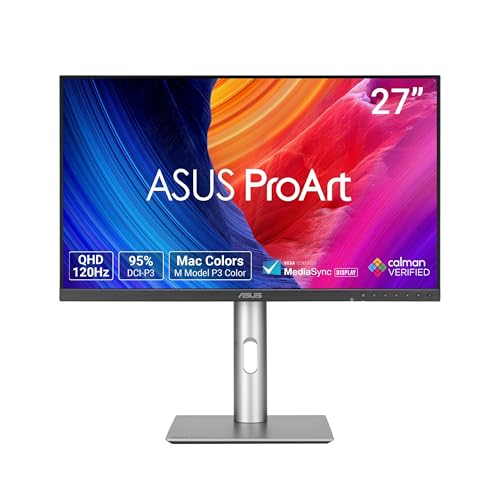
Selecting the best screen setup requires matching your daily workflow requirements to the right balance of color accuracy and responsiveness. For professional designers, photographers, and video editors demanding calibrated precision, the ASUS ProArt PA278QGV 27 Inch 1440p QHD is our premier recommendation. Its Calman-verified Delta E < 2 accuracy, 95 percent DCI-P3 gamut, ambient light sensor, and 120Hz refresh rate provide an uncompromising creative canvas.
For creators who also demand top-tier motion performance for gaming and fast media rendering, the Acer Nitro 27in QHD 2560×1440 IPS 180Hz stands out as an exceptional value. It pairs broad 95 percent DCI-P3 color coverage with a rapid 180Hz refresh rate and 0.5ms response time, making it an agile hybrid performer. It handles color-critical projects while maintaining lightning-fast frame rendering.
If you want a highly responsive display with rich contrast and HDR10 enhancement for immersive media, the Samsung 27″ Odyssey G5 (G51F) Series QHD (1440P) offers excellent versatility. Its 180Hz refresh rate, ergonomic stand, and Black Equalizer deliver balanced performance across diverse tasks. Selecting any of these capable models will elevate your daily visual precision significantly.
Frequently Asked Questions
What makes Best 1440p Monitors Color essential for creative work in 2026?
A calibrated 1440p monitor ensures that the tones and contrast levels you see on screen match the final output across web and print mediums. Choosing one of the Best 1440p Monitors Color in 2026 protects your creative projects from costly color errors and unintended oversaturation.
Why is IPS technology preferred over VA for color accuracy?
IPS panels maintain consistent hue and gamma levels across ultra-wide 178-degree viewing angles, preventing off-axis color shifts. VA panels offer higher static contrast but can suffer from subtle color shifting and gamma distortion when viewed from slight angles.
What does a Delta E measurement below 2 mean for photo editing?
Delta E measures the mathematical variation between an input color code and the physical light output generated by the panel. A Delta E value below 2 indicates that color discrepancies are imperceptible to the human eye, ensuring dependable proofing accuracy.
What is the difference between sRGB and DCI-P3 color gamuts?
The sRGB color gamut is the standard color space used for web design, online photography, and general office computing. DCI-P3 is a wider cinema-grade color space that reproduces approximately 25 percent more color volume, particularly in vibrant reds and greens.
Can high refresh rate monitors also deliver accurate colors?
Yes, modern fast IPS panels now combine rapid 120Hz to 180Hz refresh rates with wide color gamut coverage and factory calibration. This allows users to enjoy fluid motion and low input lag without compromising on tonal precision for design tasks.
How does 8-bit plus FRC differ from true 10-bit color?
Native 10-bit displays physically render 1,024 shades per color channel, whereas 8-bit plus Frame Rate Control uses high-speed pixel flickering to simulate 1.07 billion shades. In practical visual workflows, 8-bit plus FRC provides nearly identical gradient smoothness at a much lower cost.
Why is 2560 x 1440 considered the optimal resolution for a 27-inch screen?
At 27 inches, 1440p resolution provides roughly 109 pixels per inch, delivering crisp image clarity and expansive screen real estate. It avoids the heavy hardware demands of 4K while rendering sharp text without requiring excessive operating system scaling.
What is the benefit of a built-in ambient light sensor?
An ambient light sensor automatically detects room illumination changes and adjusts screen brightness and white point accordingly. This dynamic adjustment maintains consistent perceived contrast throughout the day and reduces visual fatigue during extended work sessions.
Do I need a hardware calibrator if my monitor comes factory calibrated?
Factory-calibrated displays with Calman verification provide dependable accuracy out of the box for most creative workflows. However, panels can slowly drift over thousands of operating hours, so high-end print professionals may eventually use a colorimeter for annual adjustments.
How does monitor ergonomics impact color perception?
Viewing a monitor from an improper vertical or horizontal angle can introduce subtle contrast shifts and perceived color distortion. Choosing an ergonomic stand with height and tilt flexibility ensures your screen aligns directly with your natural line of sight, consistent with ergonomic advice in our organization and setup guides.




Write Your Review
No reviews yet. Be the first to share your experience!