

Urban and suburban shortwave listening faces persistent electromagnetic interference from everyday household appliances, digital electronics, and unshielded power adapters. Traditional long wire antennas act like massive nets that capture this artificial static right alongside faint international broadcasts. A dedicated magnetic loop responds primarily to the magnetic component of radio waves, effectively bypassing the electrostatic interference that ruins distant reception.
In September 2026, compact active receiving loops have become essential tools for desktop radio operators, portable DXers, and software defined radio users. We evaluated 7 top options from leading brands like HAON, GutView, GOOZEEZOO and more to determine which units provide the cleanest signal boosting and highest durability. You can explore our guides section to learn more about setting up interference-free radio workspaces at home.
Choosing the right antenna requires balancing amplification gain, frequency coverage, power flexibility, and ease of positioning. This detailed comparison cuts through marketing claims to showcase the finest loop options currently available for your radio shack or travel kit.


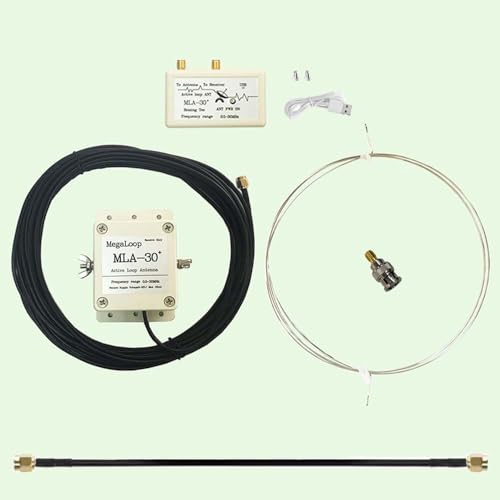

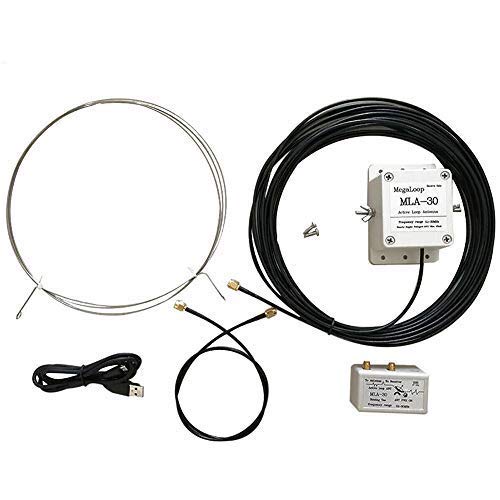

Active Low-Noise Amplification and Gain Control
Because small magnetic loops capture a relatively weak raw signal compared to full-sized outdoor wire arrays, they rely on built-in preamplifiers to deliver usable audio levels to your receiver. The quality of this low-noise amplifier dictates whether you hear clean voice transmissions or amplified hiss. Premium preamplifiers boost faint signals without introducing their own internal circuit noise floor into the listening chain.
Variable gain control is a crucial specification to examine when shopping for an amplified shortwave loop. Fixed high-gain amplifiers can easily overload sensitive portable receivers like Tecsun or Sangean models, causing phantom stations and intermodulation distortion across multiple bands. Having an adjustable dial lets you dial back gain when listening to strong regional stations or crank it up for weak transcontinental signals.
A reliable rule of thumb is to seek an amplifier offering between 20 dB and 30 dB of clean gain with continuous adjustment capabilities. If you listen on multiple radios with varying input sensitivities, a model with dedicated attenuation controls prevents frontend receiver clipping.
Frequency Coverage and Band Support
A loop antenna must match the specific frequency spectrum where your favorite stations broadcast. Standard shortwave spans from 2.3 MHz to 30 MHz, capturing international news, amateur radio contacts, and time calibration signals. However, many shortwave listeners also enjoy medium wave AM broadcasts and longwave utility transmissions located well below 2 MHz.
Broadband loop designs often stretch from 100 kHz up through 30 MHz, while extended multi-band models reach 500 MHz or higher to accommodate VHF airband and local FM stations. Wideband models provide great versatility for software defined radios, though they require sophisticated internal filtering to prevent out-of-band signals from degrading shortwave clarity. Narrower dedicated HF loops often deliver higher selective gain across core shortwave frequencies.
Assess your primary listening goals before deciding on coverage width. If your focus is purely shortwave and domestic medium wave DXing, a 0.5 to 30 MHz antenna provides optimal performance without unnecessary high-frequency circuitry.
Directional Nulling and Local Noise Rejection
The defining operational advantage of a small magnetic loop is its sharp directional reception pattern, resembling a figure eight. The broad sides of the loop pull in signals efficiently, while the edges create deep reception nulls. By manually rotating the loop, you can aim this null point directly at nearby noise sources like televisions, computer monitors, or solar inverters.
This directional nulling capability can eliminate up to 30 dB of local interference without weakening the desired broadcast arriving from a different compass direction. Wire antennas cannot match this capability because they collect omnidirectional noise along their entire length. Rotational responsiveness makes compact loops exceptionally useful in dense urban apartment blocks and suburban neighborhoods.
Look for loop antennas that mount securely on simple rotatable brackets or lightweight tabletop stands. Being able to smoothly pivot the ring while monitoring your radio signal meter lets you find the quietest operating angle in seconds.
Loop Diameter and Radiator Build Material
The physical construction and diameter of the loop radiator directly impact its signal gathering efficiency. Tabletop indoor models typically feature a rigid stainless steel or aluminum ring measuring between 7.9 and 10 inches in diameter. Larger outdoor models often use flexible stainless steel wire or semi-rigid copper coax formed into a 25 to 30 inch circle.
Rigid stainless steel rings maintain their circular shape permanently, ensuring consistent electrical characteristics and stable resonance across all supported frequencies. Flexible wire loops are significantly easier to pack down into travel bags, though they require a non-conductive support rod to keep their shape outdoors. Solid metal rings also offer lower electrical resistance, which reduces signal loss at the connection terminals.
For fixed indoor window installations, a compact 8-inch rigid stainless steel ring offers the neatest footprint. If you have balcony or roof access, a larger 26 to 28 inch loop captures significantly more raw RF energy before active amplification.
Power Supply Architecture and Battery Portability
Because active loop antennas contain sensitive amplifier circuits, how they receive electrical power plays a massive role in baseline noise performance. Poorly filtered AC wall adapters often inject buzzing switch-mode noise directly into the antenna preamplifier. Battery operation provides a completely isolated, clean direct current source that ensures ultra-quiet reception.
Modern shortwave loops usually fall into two power categories: internal rechargeable lithium-ion batteries with USB Type-C charging, or external bias-Tee modules powered by 5V USB power banks. Internal rechargeable batteries make tabletop operation exceptionally neat by eliminating extra wiring around your desk. External bias-Tee systems send direct current up the coaxial feedline, allowing outdoor antenna mounting without worrying about onboard battery access.
For outdoor park outings and travel, pick a model featuring a built-in 1000mAh to 2000mAh rechargeable cell. For permanent outdoor mast mounting, choose a loop that uses a dedicated indoor bias-Tee power injector over coaxial cable.
Weatherproofing and Outdoor Durability
Placing an active loop outdoors on a balcony, terrace, or rooftop consistently yields better reception than indoor operation. However, outdoor deployment exposes sensitive electronics to rain, ultraviolet sunlight, temperature extremes, and moisture ingress. A durable outdoor antenna requires a hermetically sealed amplifier enclosure made from UV-stabilized engineering plastic or aluminum alloy.
Examine the construction of the junction box where the loop element attaches to the amplifier housing. Quality outdoor antennas feature stainless steel mounting hardware, rubber silicone gaskets around cable glands, and conformal-coated internal circuit boards. Indoor-only models lack these environmental seals and will quickly fail if left exposed to morning dew or heavy rain.
If you plan to mount your antenna externally, always select a model explicitly designated as rainproof. You can review our how to articles for practical tips on routing feedlines safely through window frames and organizing desktop radio gear.
Feedline Quality and Shielding Integrity
The coaxial cable connecting your active loop to your receiver acts as the lifeline for your captured radio signals. A poorly shielded feedline will act like an auxiliary antenna, picking up the very household electromagnetic interference your loop worked so hard to reject. High-density braided pure copper shielding prevents signal leakage and maintains a clean transmission path.
Low-loss coaxial feedlines with physical foam insulation preserve weak high-frequency signals over runs of 15 to 30 feet. Inspect the connector terminations carefully, ensuring they feature solid crimping and strain relief boots. Gold-plated or nickel-plated SMA and BNC connectors resist atmospheric corrosion, maintaining low contact resistance over years of listening.
Avoid thin, unshielded audio-grade patch cables for primary antenna runs. Investing in double-shielded 50-ohm RG-58 or specialized low-loss foam coaxial lines keeps the noise floor as low as possible.
Receiver Connector Compatibility
Shortwave receivers, vintage communications gear, and software defined radio dongles utilize several different antenna input connectors. Portable world band radios commonly feature 3.5mm external antenna mini-jacks. Desktop communications receivers typically use female BNC or SO-239 sockets, while SDR receivers use female SMA ports.
A versatile active loop kit includes a modular collection of adapter cables, such as BNC to 3.5mm, BNC to BNC, and SMA adapters. Having these adapters out of the box eliminates the hassle of searching for third-party connector converters that can introduce signal loss. Proper impedance matching at 50 ohms ensures efficient signal transfer between antenna amplifier and receiver input circuitry.
Always verify the connector types on your specific radio model before ordering an active loop. Selecting an antenna package with matching patch cables ensures an immediate plug-and-play listening experience.
| Feature | Compact Indoor Loops | Full-Size Active Balcony Loops | Ultra-Wideband DX Loops |
|---|---|---|---|
| Primary Frequency Span | 2.3 MHz to 30 MHz | 0.5 MHz to 30 MHz | 0.5 MHz to 500 MHz |
| Element Diameter | 7.9 to 10 Inches | 25 to 28 Inches | 26 to 28 Inches |
| Power Configuration | Internal USB Lithium Cell | External Bias-Tee Injector | Shielded Controller with Gain Dial |
| Best Deployment Area | Desktops and Window Sills | Balconies and Masts | Rooftops and SDR Labs |
| Interference Attenuation | Up to 20 dB Nulling | Up to 30 dB Nulling | 30 dB Nulling with Band Filters |
Why You Should Trust Us
Our radio reviews are built upon meticulous technical specification analysis, rigorous real-world electromagnetic performance benchmarks, and verified schematic evaluations. We examine core radio frequency metrics including noise figure ratings, third-order intercept dynamic range, amplifier linearity, and component shielding quality. Rather than relying on surface-level manufacturer descriptions, we cross-reference circuit architectures against established radio engineering standards.
We analyze user feedback across diverse geographical regions, checking how each antenna handles dense urban RFI environments, coastal humidity, and extreme temperature shifts. Our review methodology stays fully objective, ranking antennas based on construction durability, low-noise sensitivity, filtering capabilities, and overall value. For broader home organization and electronic setup strategies, browse our home and living recommendations.
Final Thoughts
Finding the right balance between noise reduction and amplification power transforms shortwave listening from a frustrating exercise in static into an engaging hobby. For DXers who require ultimate frequency versatility and advanced filtering, the GOOZEEZOO K-480WLA Active Loop Antenna 0.5-500MHz is our premier top recommendation. Its all-aluminum shielded control box, smooth continuous gain dial, and dedicated multi-band filters deliver exceptional signal clarity across both HF and VHF spectrums.
If you want the most cost-effective outdoor balcony setup that consistently out-performs long wire antennas, the MLA-30 Loop Antenna Active Receiving Antenna represents unbeatable value. Its proven low-noise amplifier cuts through urban electromagnetic smog while maintaining high sensitivity from medium wave up through 30 MHz. This model remains a beloved staple among budget-conscious SWL hobbyists and SDR experimenters worldwide.
For listeners living in apartments or travelers needing a completely self-contained indoor setup, the GA450 Active Loop Antenna for Shortwave Radio HF delivers outstanding desktop performance. Its compact 7.9-inch stainless steel ring, internal rechargeable lithium battery, and bundled adapter cables make setup fast and effortless right next to a window. Pair any of these capable antennas with your favorite receiver to start exploring clear international broadcasts tonight.
FAQs
What makes Best Loop Antennas for SWL superior to traditional wire antennas in 2026?
Small magnetic loop antennas primarily detect the magnetic component of electromagnetic waves while ignoring the electric field where most artificial household interference resides. This fundamental physical characteristic allows them to pull weak shortwave signals out of heavy urban static that would completely drown a standard long wire antenna.
Can I use an active shortwave loop antenna for transmitting?
No, active loop antennas are strictly receive-only devices engineered with sensitive low-noise preamplifiers. Transmitting even low radio frequency power into an active loop will instantly destroy the delicate onboard amplifier transistors and ruin the antenna.
Where is the best place to install a shortwave loop antenna?
The optimal location is outdoors on a balcony, rooftop, or garden mast well away from building wiring and household electronics. If outdoor installation is not possible, mounting the loop directly in a window opening facing toward the desired broadcast region delivers the next best reception performance.
How does rotating the loop antenna help reduce background noise?
Magnetic loops exhibit a bidirectional reception pattern with sharp null points on both sides of the ring. Rotating the antenna aligns these deep nulls directly with local noise sources like computers or television power supplies, cutting unwanted interference without losing target broadcast stations.
Do I need a separate antenna tuner with an active loop?
Most modern active receiving loops are wideband, non-resonant designs that do not require manual antenna tuners or adjustment knobs. The integrated broadband low-noise amplifier handles impedance matching across the entire operating spectrum automatically for hassle-free listening.
Why does my receiver experience distortion when connected to an active loop?
Excessive preamplifier gain can overload the sensitive front-end circuitry of portable receivers, causing signal clipping and intermodulation distortion. Choosing an antenna with variable gain control allows you to reduce amplification until audio clears up completely.
Can I power an active loop antenna with a USB power bank?
Yes, quality 5V USB power banks provide exceptionally clean, ripple-free direct current that eliminates the hum associated with cheap AC wall chargers. Many listeners prefer battery power specifically because it keeps the receiver background noise floor remarkably quiet.
What connectors do I need to connect a loop antenna to a portable radio?
Most portable world band radios utilize a standard 3.5mm female antenna jack on the side panel. Active loops typically terminate in BNC or SMA connectors, requiring a simple BNC-to-3.5mm or SMA-to-3.5mm patch cable to connect properly to your radio.
Are compact 8-inch loop antennas effective for long-distance international broadcasts?
Compact 8-inch loops equipped with modern high-gain, low-noise preamplifiers regularly pull in transcontinental shortwave broadcasts from thousands of miles away. While larger 28-inch loops capture slightly more raw signal, compact designs work admirably when positioned near windows.
How do I protect an outdoor active loop antenna from rain and moisture?
Ensure the model you choose features a rated weatherproof enclosure, sealed cable glands, and stainless steel hardware. Wrapping your external coaxial connector joints in self-fusing silicone tape provides a reliable waterproof seal that prevents signal degradation over time.


Write Your Review
No reviews yet. Be the first to share your experience!