

Garages and home workshops often suffer from trapped heat, humidity, and poor air circulation. Installing dedicated overhead circulation transforms an uncomfortable workspace into a productive area where you can complete projects in comfort. Modern connected fixtures combine high-volume air movement with voice commands, automated scheduling, and customizable lighting to create the ultimate workspace climate.
Finding the right ventilation system for a workshop requires balancing motor strength, blade durability, and intelligent app connectivity. In September 2026, we analyzed 5 models from top brands like ECOiTEL to determine which setups handle demanding garage environments. Exploring practical home and living upgrades will help you design a workshop that stays cool even during peak summer heat.
Many homeowners make the mistake of buying standard indoor fans that warp under humidity or lack sufficient airflow for large spaces. This guide breaks down essential features including anodized aluminum construction, brushless DC motors, and smart home platform integration so you choose the perfect model.


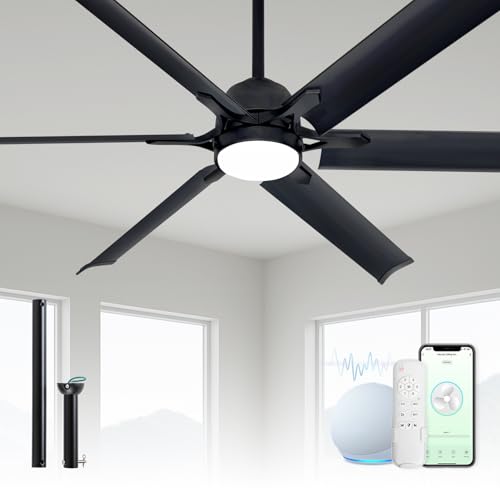
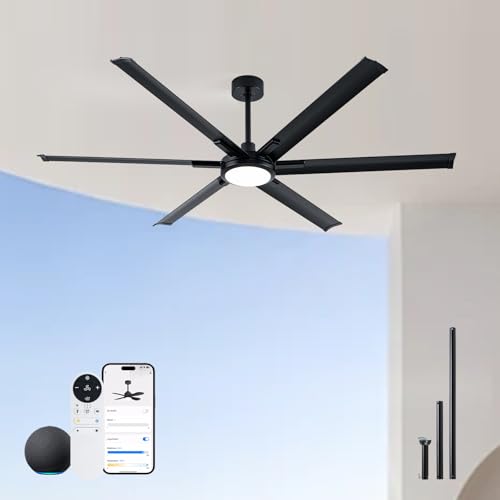
Airflow Capacity and CFM Ratings
Cubic feet per minute, commonly known as CFM, measures the volume of air a fan displaces at top speed. In a standard two-car or three-car garage, standard ceiling units often fail because they move under 4,000 CFM. For proper ventilation in open workshops, you should look for industrial-grade ratings between 6,000 and 9,500 CFM.
To calculate your minimum airflow needs, multiply your garage floor square footage by your ceiling height to get total room volume. A well-ventilated workshop requires complete air turnover every few minutes, especially when working with finishes, paint, or power equipment. High-CFM fans circulate fresh air rapidly across expansive concrete floors, preventing heat pockets from forming near the ceiling.
Pay attention to both the maximum CFM and the certified testing standards listed on product specification sheets. Some manufacturers list peak unconstrained airflow, while others report Department of Energy certified figures. Comparing certified performance metrics ensures you receive predictable breeze velocity across every speed setting.
Brushless DC Motor Efficiency and Noise Output
Brushless direct current motors represent a massive leap forward compared to legacy alternating current motors. DC motors consume up to 70 percent less electricity while generating significantly higher torque at lower speeds. This efficiency allows large industrial blades to spin steadily without driving up your monthly utility bill.
Noise control is another critical advantage of brushless DC technology in garage environments. Traditional AC motors often produce an annoying electrical hum that resonates off bare drywall and concrete walls. A premium DC unit operates between 30 and 35 decibels, creating a gentle breeze without interfering with audio systems or concentration.
DC motors also support finer speed increments, typically offering six distinct velocity settings instead of three basic speeds. This granular control allows you to dial in gentle background air exchange during winter or maximum velocity during intense summer heat. The reduced friction inside brushless housings also extends overall motor longevity significantly.
Blade Material and Moisture Resistance
Garages experience severe temperature swings and humidity fluctuations that standard composite or plywood fan blades cannot handle. Over time, compressed wood blades absorb ambient moisture, causing them to sag, warp, and wobble during rotation. Metal blades made from anodized aluminum offer the structural rigidity required for non-climate-controlled spaces.
Anodized coatings protect aluminum from oxidation, chemical fumes, and surface rust commonly found in automotive workshops. In addition to long-term durability, metal blades hold their aerodynamic pitch consistently over years of operation. For advice on maintaining gear in non-climate-controlled areas, read our open storage care guide for helpful seasonal maintenance routines.
Blade count and angle of attack also influence total efficiency and wind dispersion. Modern high-efficiency fans use five to eight contoured aluminum blades angled around 15 degrees to push massive columns of air downward. Choosing rust-resistant materials guarantees smooth, wobble-free operation throughout changing seasons.
Smart Connectivity and Voice Integration
Smart connectivity transforms how you interact with overhead ventilation while your hands are covered in grease or sawdust. Modern smart fans connect over standard 2.4GHz Wi-Fi networks and integrate seamlessly with platforms like Amazon Alexa, Google Assistant, and the Smart Life ecosystem. Simple voice prompts allow you to adjust fan speeds or toggle lighting without stepping away from your workbench.
Mobile applications provide advanced customization options, including automated schedules, countdown timers, and minute-level repeat cycles. You can set the fan to purge warm air automatically every afternoon before you arrive home from work. Grouping features in companion apps also let you control multiple workshop fans simultaneously with a single tap.
When selecting a connected fan, ensure the mobile software includes comprehensive automation triggers based on local weather conditions. Smart app integration should also operate independently of physical remotes so every family member can adjust settings easily. Reliable wireless pairing ensures your device remains reachable throughout your property.
Integrated Lighting Performance and Color Temperature
Proper illumination is critical when performing mechanical repairs, woodworking, or precision assembly in a garage. Built-in LED light kits eliminate the need for separate overhead fixtures directly above your central workspace. Premium fixtures offer dimmable output from 10 percent up to 100 percent brightness to suit delicate tasks or ambient lighting.
Adjustable color temperature allows you to tailor light output between 3000K warm white and 6000K daylight crispness. Cool daylight settings around 5000K to 6000K enhance contrast and visibility, helping you spot small hardware pieces and surface imperfections. Warm settings near 3000K create a relaxed atmosphere when using the garage as a social space.
Look for light modules protected by reinforced polycarbonate covers rather than thin, brittle plastics. Heavy-duty twist-lock lenses resist cracking from stray project debris and will not discolor under intense LED heat. Long-lasting integrated diodes save you the hassle of climbing ladders to replace burned-out bulbs.
| Fan Size | CFM Range | Ideal Garage Size | Motor Decibels | Recommended Mounting |
|---|---|---|---|---|
| 60 Inch | 5,500 – 6,200 CFM | 1 Car / Small Workshop | Under 30 dB | Standard Downrod (6″-12″) |
| 62 – 65 Inch | 6,400 – 9,100 CFM | 2 Car Garage / Deep Bay | 30 – 32 dB | Extended Downrod (12″-24″) |
| 72 Inch | 6,800 – 9,500 CFM | 3 Car Garage / Pole Barn | 30 – 35 dB | High Downrod (24″-48″) |
Ceiling Height and Downrod Selection
Mounting height directly dictates how effectively a ceiling fan circulates air across your garage floor. For safety and optimal airflow, fan blades should hang at least seven feet above the finished floor surface. If your garage features high or vaulted ceilings, you will need an extended downrod to position the blades properly.
Most garage fans include versatile six-inch, twelve-inch, or twenty-four-inch downrods in the box to accommodate standard eight-to-ten-foot ceilings. For taller pole barns and cathedral roofs, modular coupler systems allow you to combine downrods up to 72 inches. Maintaining ten to twelve inches of clearance between the blades and the ceiling ensures unrestricted intake.
Sloped ceiling compatibility is another crucial detail to check before purchasing mounting hardware. Quality mounting brackets accommodate angled ceilings up to 12 degrees out of the box. Verifying your roof pitch and overhead clearances prevents awkward installations and ensures smooth airflow distribution.
Reversible Motor Direction for Year-Round Use
Ceiling fans provide significant climate benefits during cold winter months as well as sweltering summers. In downward forward mode, counter-clockwise rotation pushes a direct, cooling column of air over your skin to accelerate evaporation. This wind-chill effect makes unconditioned spaces feel up to eight degrees cooler during hot weather.
In reverse mode, clockwise blade rotation draws cooler air upward toward the ceiling, displacing trapped hot air outward and down walls. This process, known as destratification, redistributes heat produced by garage space heaters without creating an uncomfortable draft. Keeping air circulating year-round also prevents condensation from rusting valuable hand and power tools.
Modern DC motors feature electronic reversing controlled directly via mobile app or handheld remote. You no longer need to climb a ladder to flip a physical switch on the motor housing. Year-round thermal balancing makes smart overhead fans an indispensable workshop investment.
Power Memory and Fail-Safe Features
Garage electrical circuits often experience interruptions when using high-draw power tools or tripped breakers. A fan with comprehensive memory retention restores its previous speed, rotation direction, and lighting status immediately after power returns. This feature prevents you from having to reprogram your favorite fan settings repeatedly.
Smart memory also safeguards lighting preferences so that lights that were switched off remain off when power is restored. This prevents unexpected midnight illumination if your neighborhood experiences a brief power outage. Consistent setting retention streamlines your workflow and saves valuable setup time in the shop.
When shopping for storage and utility fixtures, choosing dependable electrical components gives lasting peace of mind. You can explore our expert shopping guides to discover more hardware solutions designed for long-term reliability. Reliable memory chips ensure your garage ventilation remains hassle-free every single day.
Why You Should Trust Us
Our evaluation process focuses on rigorous technical analysis, certified aerodynamic performance data, and real-world garage demands. We examine manufacturer specifications, Department of Energy airflow certifications, motor build quality, and wireless protocol stability. By comparing component materials and engineering designs side by side, we identify fixtures built to endure harsh workshop environments.
We do not accept paid brand placements or promotional incentives when compiling our buyer guides. Every model is evaluated on practical utility, material longevity, smart ecosystem integration, and overall value. Our recommendations reflect transparent data so you can invest in the best equipment for your home.
Final Thoughts
Selecting the ideal ventilation system keeps your garage comfortable and functional through every season. If you manage a large two-car or three-car workshop with high ceilings, the 72 Inch Smart Outdoor Covered Ceiling Fan delivers exceptional power. Its 9,496 CFM peak airflow and durable eight-blade aluminum structure circulate air effortlessly across expansive floor plans.
For standard two-car garages where overhead clearance is limited, the 65 Inch Outdoor Ultra-Thin Ceiling Fan stands out as an ultra-slim top performer. Its low-profile 3.54-inch motor housing maximizes vertical space while operating under 30 decibels. If you are outfitting a compact single-bay garage on a budget, the 60 Inch Aluminum Smart Ceiling Fan offers impressive air movement and full Alexa voice connectivity.
Organizing a clean, functional workspace makes every DIY build and automotive repair much more enjoyable. Pair your new ventilation system with practical ideas from our how to guides to optimize your storage layout. Upgrading your airflow today turns your garage into a welcoming haven for all your upcoming projects.
FAQs
What makes the Best Smart Fans for Garages different from regular indoor ceiling fans?
Garage fans feature heavy-duty anodized aluminum blades and sealed DC motors designed to resist humidity and temperature extremes. Standard indoor units often utilize composite wood blades that droop or warp in non-climate-controlled environments. Connected garage models also offer much higher CFM ratings to move air across open workspaces.
How much airflow CFM is required for a standard two-car garage?
A typical two-car garage measuring between 400 and 500 square feet requires a fan producing at least 6,000 CFM. Choosing a model that reaches 8,000 to 9,000 CFM provides superior ventilation during hot summer afternoons. High CFM ratings ensure air circulates into corners and prevents stagnant heat build-up.
Can I control Best Smart Fans for Garages using voice commands?
Yes, modern smart fans integrate with Amazon Alexa, Google Assistant, and the Smart Life mobile ecosystem over 2.4GHz Wi-Fi. This allows you to adjust speeds, toggle lights, or reverse rotation hands-free while working on messy projects. You can also automate daily schedules through mobile companion apps.
Are aluminum fan blades better than plastic or wood blades for workshop use?
Anodized aluminum blades are significantly better for garages because they resist moisture, temperature swings, and chemical vapors. Wood blades absorb ambient dampness and warp over time, leading to severe motor wobble. Metal blades retain their aerodynamic pitch indefinitely to maintain consistent high-speed airflow.
How low should a garage ceiling fan hang from the ceiling?
For safety and optimal performance, fan blades should hang between seven and nine feet above the finished floor. Maintaining at least ten to twelve inches between the blades and the ceiling allows adequate air intake. Included downrod options let you adjust drop height to match standard or vaulted ceilings.
Do smart garage fans work on sloped or vaulted ceilings?
Most industrial-style smart fans include specialized mounting canopies that support ceiling slopes up to 12 degrees. If your garage has a steeper roof pitch, aftermarket angled mounting kits can accommodate steeper angles. Always ensure the blade tips clear sloped walls by at least eighteen inches.
Will a smart garage fan help lower heating bills during winter?
Reversing the fan to clockwise rotation pushes trapped ceiling heat down the walls and across the floor without creating a chilly breeze. This destratification balances room temperatures and allows garage heaters to run less frequently. For more space-saving organization ideas, check our guide on how to simplify your storage system.
What is the benefit of a brushless DC motor in Best Smart Fans for Garages in 2026?
Brushless DC motors use up to 70 percent less electricity while generating higher torque and virtually silent operation around 30 decibels. They offer multiple precision speed settings and electronic reverse functionality right from your smartphone. The reduced internal friction also extends overall motor service life significantly.
Can I leave a smart garage ceiling fan running unattended?
Yes, built-in timer functions and mobile scheduling allow you to run automated air-purging cycles safely when you are not in the room. You can program the fan to shut down automatically after one, four, or eight hours. Premium DC motors feature thermal overload protection to ensure safe continuous operation.
Do these smart ceiling fans remember my settings after a power outage?
High-quality smart fans include non-volatile memory chips that retain your last speed, rotation direction, and lighting preferences. When power returns after a storm or circuit interruption, your custom settings resume automatically. This fail-safe prevents lights from turning on unexpectedly during power fluctuations.



Write Your Review
No reviews yet. Be the first to share your experience!