Quick Answer
The best coat racks make outerwear easy to grab while keeping the entry path clear and the load stable. The Pipishell Solid Wooden Coat Rack is a balanced overall starting point because its listing combines eight hooks, three height options, pine construction, tool-free assembly, and a triangular base. That format suits hats, scarves, handbags, and everyday coats in an entryway, bedroom, or office, provided the weight is distributed around the stand.
Homes that need seating and shoe storage may prefer the VASAGLE 4-in-1 Hall Tree, while the Yoobure Metal Coat Rack pairs 12 hooks with a marble base and umbrella holder. A wall-mounted rail saves floor area, and the SONGMICS 16-Hook Metal Coat Tree offers more hanging positions on adjustable feet. The best coat racks depend less on the highest hook count than on safe placement, base or wall support, and the types of items used every day.


Top Picks at a Glance
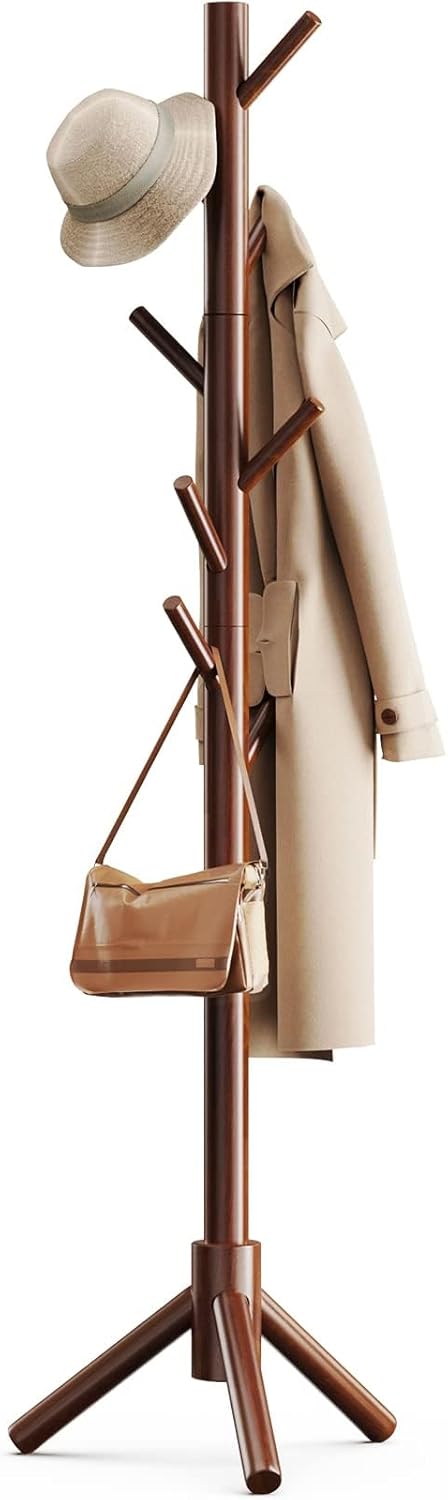
- Best Overall: Pipishell Solid Wooden Coat Rack. An eight-hook pine coat tree with three height options and tool-free assembly.
- Best Traditional Wood Design: VASAGLE Solid Wood Coat Rack and Stand. A caramel-brown rubberwood stand with ten hooks for outerwear and accessories.
- Best Hall Tree with Bench: VASAGLE 4-in-1 Hall Tree with Shoe Bench. A larger organizer with nine removable hooks, a hanging rod, and entryway seating.
- Best Weighted Base and Umbrella Storage: Yoobure Metal Coat Rack with Marble Base. A 12-hook metal tree with an integrated umbrella holder.
- Best Stable Wood-Base Option: MISSLO Heavy Duty Freestanding Coat Rack. A modern black stand with 12 hooks and an adjustable format.
- Best High Hook Count: SONGMICS 16-Hook Metal Coat Tree. A metal stand with four adjustable feet for leveling.
- Best Wall-Mounted Option: Five Tri-Hook Stainless-Steel Coat Rack Rails. A black two-pack that moves storage off the floor when properly mounted.
What Makes the Best Coat Racks Work?
The best coat racks support the routine that happens at a doorway: arrive, remove a coat or bag, set down wet accessories, and find everything again when leaving. A useful rack places hooks within comfortable reach, leaves garments enough room to hang, and does not force people to step around a projecting base. It should also remain predictable when one person removes an item from a partially loaded side.
Measure for the Best Coat Racks and a Clear Path
Measure the full placement zone, not only the width of the center pole. Freestanding feet, a marble base, hanging sleeves, handbag straps, and open umbrellas can extend into the walkway. Record wall width, floor depth, ceiling height, door swing, nearby furniture, and the minimum clear path needed through the entry.
If the real need is a portable wardrobe rather than a landing place for outerwear, compare clothing racks. For seating plus shoe storage, the category overlaps with entryway benches. A larger unit with hooks, shelves, and a bench belongs closer to the hall tree category. Defining the storage job prevents buying a compact coat tree for a full mudroom problem.
Base Design, Balance, and Tip Resistance
Stability is central to the best coat racks because coats and bags rarely arrive in perfectly even loads. A triangular wood base spreads contact points around a center post. A broad wood platform adds area, while a marble base puts mass low. Adjustable feet can compensate for slight floor variation, but none of these designs cancels the effect of a heavy backpack hanging high on one outer hook.
Load the rack gradually and alternate sides. Place heavier items on lower or inward hooks when the design allows, and do not use the maximum published capacity as a daily target. Hook strength, center-pole strength, and resistance to tipping are different questions. A hook may support an item without the whole stand remaining balanced.
Choose the Best Coat Racks by Hook Layout
The best coat racks do not necessarily have the most hooks. Ten well-spaced hooks may be more useful than sixteen crowded positions hidden beneath bulky winter coats. Count the categories the household actually hangs: adult coats, children’s jackets, hats, scarves, handbags, umbrellas, dog leashes, and backpacks. Then decide which items need dedicated access and which belong in a drawer, basket, or closet.
Hook height affects both convenience and stability. High hooks are comfortable for long coats but tempting places for heavy bags that raise the center of gravity. Lower hooks help children reach their own jackets, though they may project near faces or shoulders. Adjustable-height models can suit different users, but verify how the sections lock and whether every advertised height preserves the intended stability.
Inspect hook shape and spacing. Rounded ends and smooth finishes reduce snag risk, while upward tips help straps remain in place. Thick coats need more separation than caps or scarves. Removable hooks, such as those listed on the VASAGLE hall tree, can let the layout adapt, but unused holes and attachment points should remain secure and finished.
Freestanding, Wall-Mounted, or Hall Tree?
A freestanding tree is easy to place and relocate, making it suitable for rentals, offices, bedrooms, and corners where drilling is undesirable. It also concentrates weight in a narrow footprint. Keep it out of the direct door arc and resist pushing it tight against a wall if the hooks or garments will scrape the finish.
A wall-mounted rail can be one of the best coat racks for a narrow entry because it frees the floor and establishes a clear row of hooks. Its safety depends on the wall structure and installation. Locate studs where possible, use the specified anchors for the wall type, keep the rail level, and respect both per-hook and total load instructions. Supplied hardware is not automatically correct for every wall.
A hall tree adds functions: the VASAGLE listing includes a shoe bench, hanging rod, and removable hooks, while the industrial-style freestanding listing combines seven hooks with three shelves. These units can organize more categories but need greater depth and assembly effort. Confirm bench-use instructions, shelf clearances, anti-tip guidance, and whether the unit must be anchored.
Materials, Wet Outerwear, and Assembly
Wood gives the best coat racks a warmer furniture-like appearance and can work well in living spaces. Pine and rubberwood differ in grain, density, and finish, but both should be protected from prolonged moisture. Inspect threaded wood connections periodically and avoid forcing tool-free joints beyond their intended stop.
Metal frames can create slimmer profiles and support numerous hooks. Check welds, threaded connections, protective caps, and coating condition. A stone or marble base adds low weight but can be difficult to move and vulnerable to edge damage if dropped. Lift from the locations specified by the manufacturer rather than carrying a tall stand by its hooks.
Wet coats need air between them. Do not bury a damp jacket beneath several dry garments, and do not allow umbrella water to pool on wood, laminate, or vulnerable flooring. An umbrella holder is useful only when its drip area is easy to empty or protect. Dry the rack surface promptly and follow the finish-care instructions instead of using harsh household cleaners.
During assembly, count parts, protect the floor, and follow the sequence in the manual. Square shelf units before tightening, confirm that feet or bases are fully seated, and use a second person for tall or bench-style frames when recommended. Retighten permitted hardware after the first weeks of use rather than waiting for obvious movement.
How We Tested & Evaluated
We did not conduct hands-on tip, load, or finish testing. We used Crawlbase to review Amazon results for the best coat racks search and verified each selected product name inside its individual result block. We then compared observable listing details: hook count, height adjustment, base design, wall mounting, bench or shelf storage, umbrella accommodation, and material language.
The labels in Top Picks describe configuration rather than unverified performance. The Pipishell model represents a simple adjustable wood tree; the VASAGLE products cover a traditional wood stand and a bench-style hall tree; the Yoobure listing adds a marble base and umbrella holder; SONGMICS emphasizes hook count and adjustable feet; and the wall rail illustrates a floor-saving alternative. Confirm current dimensions, mounting parts, and load instructions on the live listing.
Common Mistakes to Avoid
Before choosing among the best coat racks, avoid these preventable problems:
- Choosing by hook count alone: Bulky coats need spacing, and crowded hooks make items difficult to remove.
- Loading one side first: Alternate sides and keep heavy bags lower or closer to the center.
- Ignoring the traffic path: Measure the base, hanging garments, door swing, and clear exit width.
- Using generic wall anchors: Match mounting hardware to the wall material and expected load.
- Hanging wet items in a dense layer: Provide airflow and protect the floor from drips.
- Assuming a weighted base cannot tip: High, uneven loads can still shift the center of gravity.
- Forgetting children and pets: Avoid accessible climbing points, sharp projections, and unstable locations.
Buying Checklist
Use this checklist to narrow the best coat racks for the household:
- Measure the full base or rail width, hook projection, height, door swing, and walking clearance.
- List the coats, hats, scarves, bags, backpacks, umbrellas, and other items used daily.
- Choose a freestanding tree, wall rail, hall tree, bench, shelf, or umbrella-holder format.
- Compare base geometry, adjustable feet, mounting points, and anti-tip instructions.
- Check hook height, spacing, finish, per-hook guidance, and total load guidance.
- Confirm material care for wet outerwear and compatibility with the wall and floor.
- Review assembly tools, helper requirements, included hardware, warranty, and return logistics.
FAQ
What are the best coat racks for a small entryway?
The best coat racks for a small entryway preserve a clear path and match the household’s actual outerwear. A properly mounted wall rail uses no floor area, while a narrow coat tree can fit a corner without drilling. Measure garment projection and door swing, not just the rack itself.
Are freestanding coat racks stable?
They can be stable when correctly assembled, placed on a suitable level floor, and loaded evenly within the manufacturer’s guidance. Stability decreases when heavy bags are placed high on one side or when the stand is repeatedly bumped. Base weight alone does not eliminate tipping risk.
Is a wall-mounted coat rack better than a coat tree?
A wall rail is often better where floor space is scarce and the wall can support proper mounting. A coat tree is easier to relocate and does not require holes. The decision depends on wall structure, rental restrictions, load, and whether the entry layout can accommodate a base.
Can a coat rack hold backpacks and heavy winter coats?
Only when the hook, frame, base or mounting hardware, and total load guidance support them. Backpacks create concentrated weight and should not be placed high on the outermost hook of a freestanding tree. Spread heavy coats and use lower storage when available.
How many hooks should a family coat rack have?
Count everyday items and allow room between bulky coats. A family may benefit more from eight to twelve accessible hooks plus a basket than from a crowded stand with many positions. Extra hooks are useful for hats and scarves only if they remain reachable.
What is the difference between a coat rack and a hall tree?
A coat rack primarily provides hooks or a hanging rail. A hall tree usually combines hanging storage with a bench, shelves, shoe storage, or a larger frame. Hall trees organize more categories but require additional floor depth and may need wall anchoring.
Final Takeaway
The best coat racks fit the entry routine as carefully as they fit the decor. Measure the base, garment projection, hook reach, and clear path; then choose between a movable tree, mounted rail, or full hall tree. Balance heavy items, protect the floor from wet outerwear, and follow assembly or mounting instructions. A thoughtful layout will usually matter more than adding the largest possible number of hooks.