

Creating vibrant physical reproductions of your illustrations, paintings, and digital artwork demands far more capability than a standard desktop office unit can provide. Professional creators need expansive color gamuts, archival ink permanence, and the ability to feed heavy textured watercolor papers without jamming or scuffing delicate surfaces.
We evaluated 5 options across top industry brands like Epson, Canon to determine which machines deliver true gallery-grade results for independent creators in September 2026. Whether you sell limited edition prints online or produce custom greeting cards in your home workspace, selecting the proper hardware protects your artistic integrity and profit margins.
Investing in a dedicated studio printer eliminates expensive third-party print shop delays while giving you complete creative control over every proof. You can also explore our helpful studio buying guides to discover additional organizational tools that keep your creative workspace productive and efficient throughout the creative season.

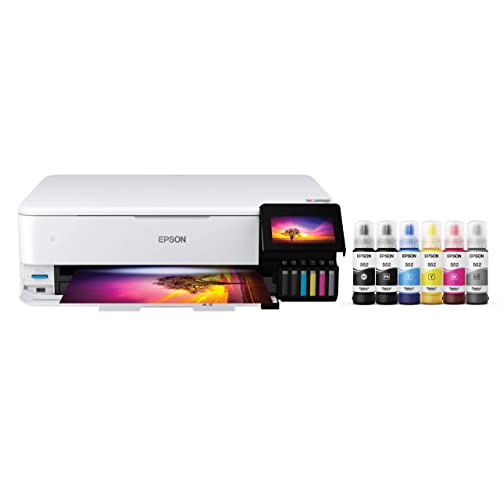


Choosing the right reproduction hardware requires balancing chemical ink properties, mechanical paper feed mechanisms, and overall running costs. Understanding how these technical specifications translate to real-world art prints ensures your final artwork looks just as striking on paper as it does on your display screen.
1. Pigment-Based vs Dye-Based Ink Formulations
The primary chemical distinction in fine art reproduction lies between pigment and dye ink sets. Pigment inks utilize microscopic encapsulated color particles suspended in liquid, providing outstanding lightfastness and archival stability lasting upwards of a century without noticeable fading. Dye inks dissolve colorants completely into solution, resulting in brilliant saturation on glossy surfaces but shorter archival life under direct ultraviolet exposure.
When inspecting printer specifications, identify whether the machine utilizes a pure pigment array like Canon LUCIA PRO II or a specialized dye-based photo system. Pigment formulations excel on matte, rag, and textured fine art papers because the particles rest upon the surface fibers instead of soaking deep into the material. Dye inks absorb into paper coatings, making them vibrant choices for student portfolios, stickers, and promotional posters where century-long longevity is not the primary commercial requirement.
As a practical rule of thumb, select pigment systems if you intend to sell signed, limited-edition fine art prints to collectors. If your primary catalog consists of high-volume event merchandise, glossy stickers, or entry-level craft items, high-density dye engines offer vivid color brilliance at a significantly faster initial drying cadence.
2. Number of Discrete Ink Channels and Color Gamut
Standard office machines rely on a simple four-color CMYK process that frequently struggles with subtle gradients, skin tones, and rich shadow details. Professional fine art printers expand this palette to six, eight, ten, or even eleven individual ink tanks. These dedicated extra channels introduce intermediate tones like photo cyan, photo magenta, gray, light gray, and distinct matte black shades.
A wider ink assortment directly expands the color gamut, allowing the machine to match demanding Adobe RGB and specialized Pantone color targets faithfully. Dedicated gray and light gray channels prevent color casts in monochrome illustrations and dark moody paintings, rendering neutral shadow gradations smoothly. Furthermore, dedicated matte black inks deliver dense black optical density on uncoated cotton rag without wasting glossy photo black ink during channel conversions.
Evaluate your portfolio palette before choosing your channel count. Watercolor artists and portrait illustrators benefit immensely from eight or more ink channels to capture subtle wash transitions. Graphic designers working primarily with solid vector shapes and bold primary tones can often achieve superb results using six-color systems while saving on overall cartridge replacement complexity.
3. Maximum Media Width and Cut-Sheet Versatility
Physical print dimension constraints dictate the commercial products you can manufacture in-house. Studio printers typically fall into three standard width categories: standard 8.5-inch letter size, 13-inch wide format (A3+ or Super B), and expansive 17-inch pro-grade cut-sheet desktop units. Operating a 13-inch or 17-inch printer allows you to produce full-bleed gallery posters, custom calendars, and large display illustrations without outsourcing.
Examine the edge-to-edge borderless printing capabilities across different standard dimensions. High-end art printers allow borderless output from small 3.5×3.5 inch square cards all the way up to 13×19 inch or 17×22 inch exhibition sizes. Producing borderless art prints saves countless hours of manual trimming and ensures consistent white border margins when mounting artwork inside standard pre-cut framing mats.
If you plan to sell at craft fairs or online marketplaces, a 13-inch wide format represents the ideal sweet spot between studio footprint and commercial versatility. It accommodates popular 11×14 and 12×18 inch print sales while still fitting on a standard studio desk setup without requiring dedicated industrial floor stands.
4. Paper Weight Support and Specialty Media Feeding
Fine art papers differ substantially from smooth commercial cardstock. Heavyweight cotton rag, baryta paper, and canvas sheets frequently feature basis weights exceeding 300 grams per square meter (gsm) and thicknesses up to 0.5 millimeters. Standard bottom paper cassettes utilize tight U-bend rollers that cause heavy art substrates to jam, buckle, or experience edge strike marks from the printhead.
Look for dedicated rear feeding trays or specialized manual straight-through feed slots designed explicitly for heavy fine art media. Advanced printers also incorporate mechanical skew correction and air feeding systems that pull delicate sheets flat against the vacuum platen. This mechanical precision prevents thick paper edges from lifting into the carriage path during high-density multi-pass ink delivery.
Always verify the maximum supported media thickness in the manufacturer specifications before ordering specialty fine art rolls or sheets. A printer capable of handling at least 300 to 400 gsm ensures complete freedom when experimenting with luxurious velvet textured papers, printable metallic foils, and thick archival museum boards.
5. Ink Delivery Architecture and Long-Term Operating Costs
Operating costs in art reproduction can rapidly exceed the initial purchase price of your printer hardware. Modern hardware generally falls into two distinct categories: refillable high-capacity Supertank ink reservoir systems or high-volume individual replacement cartridge systems. Refillable tank models dramatically lower ongoing page costs, making daily proofing and high-volume merchandising exceptionally economical.
Individual cartridge systems feature specialized high-capacity cartridges ranging from 12ml up to 80ml per color channel. While cartridge replacements represent a larger upfront expenditure per set, professional pigment cartridges contain advanced chemical binders and degassing membranes that maintain ultra-precise droplet placement across demanding gallery surfaces. Review our detailed how to articles for helpful advice on balancing studio operating expenses against commercial print volume demands.
Calculate your anticipated monthly output before committing to an ink platform. If you produce hundreds of art market cards, stickers, and open-edition prints weekly, a high-yield bottle tank system delivers unbeatable profit margins. If your primary focus is low-volume, high-ticket museum reproductions, large pigment cartridges deliver the ultimate in pigment density and gloss uniformity.
6. Printhead Technology and Micro-Droplet Precision
The printhead is the mechanical core of any imaging device. Two primary printhead architectures dominate the professional artistic landscape: thermal bubble jet systems and piezoelectric crystal actuators. Micro Piezo printheads mechanically flex to eject ink without applying heat, preserving chemical stability across complex organic pigment formulas and delivering uniform droplet sizing down to microscopic picoliter volumes.
Thermal FINE printhead systems utilize thousands of microscopic thermal nozzles to lay down dense arrays of ink at exceptional linear speeds. Modern professional printheads also incorporate active anti-clogging sensors that detect misfiring nozzles in real time, automatically compensating with adjacent nozzles to prevent ruined prints halfway through a large 13×19 inch artwork rendering.
Look for hardware that features user-replaceable printheads and dedicated maintenance cartridges. Having an easily swappable printhead assembly prevents costly studio downtime and eliminates the need to ship an entire heavy wide-format chassis to an external service center if a nozzle ever suffers permanent mechanical wear.
7. Color Management, ICC Profiles, and Studio Layout Software
Achieving screen-to-print color consistency requires robust color management integration. An ICC profile acts as a digital translator between your graphic software color space, your operating system, and the specific chemical interaction between your ink and paper combination. Professional art printers provide native profile support for leading fine art paper mills including Hahnemuhle, Canson Infinity, and Moab.
Inspect the bundled layout software provided by the manufacturer. Standalone printing applications like Canon Professional Print & Layout or specialized Adobe Photoshop plugins allow artists to perform accurate soft proofing, nested multi-image gang printing, and fine-tuned gallery wrap canvas border adjustments directly from the desktop without purchasing expensive third-party RIP software.
Before sending final artwork to print, always verify that your operating system printer driver allows you to disable automatic OS color corrections. Letting your dedicated creative software or native manufacturer plugin manage color profiles ensures pristine tonal transitions without conflicting color adjustments flattening your original illustration palette.
8. Gloss Uniformity and Surface Optimization Coatings
When printing on glossy, semi-gloss, or luster art papers, pigment inks can occasionally display uneven surface reflections known as bronzing or differential gloss. This visual artifact occurs because the physical thickness of pigment particles varies across highlight and dark shadow areas, causing light to scatter irregularly across the finished art piece.
Top-tier pigment printers solve this challenge by integrating a dedicated clear coat channel, such as a Chroma Optimizer or gloss enhancer. The printer applies this clear resin over the entire image area, filling microscopic valleys between pigment deposits to create a perfectly flat, uniform reflective surface that enhances visual depth and scratch resistance.
If your artistic portfolio relies heavily on high-gloss photo finishes, metallic papers, or deep saturated luster finishes, selecting a machine equipped with a dedicated Chroma Optimizer channel is essential. It completely eliminates bronzing artifacts while providing extra surface protection against studio handling and framing friction.
9. Studio Connectivity and Workflow Integration
Modern studio workflows require flexible connectivity options to accommodate laptops, desktop workstations, and mobile digital drawing tablets. Professional printers now incorporate high-speed Wi-Fi 5 GHz bands, Ethernet network jacks, and direct high-speed USB interfaces to ensure swift transmission of massive, uncompressed graphic files exceeding several gigabytes in size.
Integrated color LCD touchscreens streamline daily studio production by displaying real-time ink volume percentages, active media profile settings, and step-by-step visual guides for loading specialty cut sheets. This visual feedback prevents costly mistakes, such as sending an A3+ job to a tray configured with letter-sized watercolor paper.
Ensure your studio network supports stable wireless or hardwired Ethernet routing. While wireless AirPrint allows convenient proofing directly from an iPad drawing app, routing final high-resolution exhibition files through a hardwired USB or Ethernet connection guarantees uninterrupted data packet delivery during large multi-pass printing runs.
10. Studio Footprint and Workspace Layout Requirements
Wide-format fine art printers possess substantial physical dimensions and require adequate clearance around all sides for paper feeding and output trays. A 13-inch or 17-inch printer requires not only desk width, but also substantial front and rear depth when the manual straight-through feed trays are fully extended to receive thick poster stock.
Consider environmental factors within your workspace as well. Fine art printers perform best in stable environments with moderate humidity between 40 and 60 percent. Excessive dryness can accelerate ink drying within printhead nozzles, while high humidity can delay paper ink absorption. You can find excellent inspiration for creative home and living setups to organize your dedicated creative production zone cleanly.
Measure your planned studio table depth carefully before purchasing a professional wide-format unit. Ensure you have at least ten to twelve inches of clear clearance behind the rear feed slot to prevent thick fine art paper sheets from bending against your studio walls during initial automated alignment cycles.
| Printer Feature | Entry-Level Supertank | Mid-Range Wide-Format | Professional Pigment Studio |
|---|---|---|---|
| Ink Technology | 4-Color Dye & Pigment Hybrid | 6-Color Claria ET Dye & Pigment | 8 to 11 Color LUCIA PRO II Pigment |
| Maximum Paper Width | 8.5 Inches (Letter) | 13 Inches (A3+) | 13 to 17 Inches (Super B / Exhibition) |
| Archival Longevity | Standard Display Life | Up to 50+ Years Display | 100+ Years Museum Archival |
| Specialty Media Handling | Standard Rear Feed (Up to 200 gsm) | Straight-Through Rear (Up to 300 gsm) | Air-Feed & Skew Correction (Up to 400+ gsm) |
| Primary Best Use Case | Stickers, Craft Projects, Invoices | Art Prints, Greeting Cards, Proofing | Limited Editions, Fine Art Sales, Galleries |
Why You Should Trust Us
Our review team focuses exclusively on objective technical analysis, printhead engineering specifications, and verifiable real-world media capabilities. We thoroughly analyze ink formulation chemistry, droplet placement precision, ICC profile compatibility, and long-term operating costs to deliver unbiased buying recommendations tailored specifically to visual artists, illustrators, and printmakers.
We do not rely on generic promotional claims or generalized office printing benchmarks. Instead, our evaluations examine the precise performance metrics that matter directly to creative studios, including paper thickness tolerances, optical black density scores, anti-bronzing technologies, and software layout integration with major creative platforms.
Our comparative database is continuously audited to reflect updated firmware releases, newly released hardware iterations, and evolving market pricing dynamics. This ongoing refinement guarantees that our recommendations remain completely accurate and actionable for artists establishing or upgrading their production studios in September 2026.
Final Thoughts
Selecting the ultimate printing partner for your creative practice comes down to your primary artwork medium, anticipated production volume, and the longevity standards demanded by your audience. Investing in dedicated hardware pays immediate dividends in artistic control, immediate turnaround times, and outstanding reproduction fidelity across all your creative merchandise.
For creators seeking absolute exhibition-grade quality with true museum permanence, the Canon imagePROGRAF PRO-1100 represents our top overall professional studio pick. Its 11-color LUCIA PRO II pigment system, integrated Chroma Optimizer, and robust air-assisted feed mechanism provide unmatched dynamic range, scratch resistance, and breathtaking black density on thick cotton rag media.
If you require an exceptional balance of wide-format 13-inch creative capability with remarkably low ongoing ink expenses, the Epson EcoTank Photo ET-8550 Wireless Wide-Format is our premier high-value recommendation. Its cartridge-free tank architecture and 6-color Claria ET Premium ink set allow independent artists to print hundreds of vibrant art prints, greeting cards, and proofs at a fraction of traditional cartridge costs.
For artists desiring professional pigment longevity in a more compact 13-inch chassis, the Canon PIXMA PRO-200S Professional 13″ and Canon imagePROGRAF Professional 13″ PRO-310 provide exceptional color fidelity and dedicated skew correction. Setting up your studio with budget studio storage solutions will keep your fine art paper flat, dry, and ready for immediate high-volume print runs.
FAQs
What makes a printer suitable for fine art reproduction?
A fine art printer must offer a wide color gamut through multiple specialized ink channels, support heavyweight textured rag papers up to 300 gsm or more, and provide precise ICC profile color management. These features ensure that physical prints faithfully match the artist original digital illustration or physical painting without unwanted banding or color shifts.
Are pigment inks always better than dye inks for artists?
Pigment inks are the industry benchmark for archival fine art prints and gallery sales because they resist light fading for over a century. Dye inks, however, offer slightly higher initial saturation and gloss levels on smooth photo papers, making them outstanding and cost-effective choices for promotional stickers, craft merchandise, and student portfolios.
Can I feed thick watercolor paper through a standard printer?
Standard office printers with curved paper paths will jam and damage thick watercolor papers. Studio art printers feature specialized rear manual feed slots or straight-through paper paths specifically designed to guide rigid, heavy-weight fine art sheets smoothly without bending or scuffing the delicate surface fibers.
What is the top-rated option among Best Color Printers for Artists in 2026?
The top-rated professional model is the Canon imagePROGRAF PRO-1100, which offers an expansive 17-inch print width, an 11-color pigment system, and an integrated Chroma Optimizer for flawless surface reflections. For high-volume printmakers watching their operating budget, the Epson EcoTank Photo ET-8550 stands out as the top high-yield wide-format alternative.
How much does it cost to produce fine art prints at home?
Printing in your own studio typically cuts reproduction costs by 50 to 75 percent compared to commercial print-on-demand services. Cartridge-based pigment systems cost slightly more per sheet in ink consumables, whereas bottle-fed tank printers reduce ink expenses to mere cents per standard art print.
What is a Chroma Optimizer and why is it important for art prints?
A Chroma Optimizer is a dedicated clear coat ink applied across the image area to level the microscopic surface height differences between pigment particles. This coating eliminates uneven gloss reflections known as bronzing, deepens perceived black density, and provides added scratch resistance during handling.
How do custom ICC profiles improve print accuracy?
ICC profiles tell your graphics software exactly how a specific printer and ink set will react on a particular paper texture. Loading the correct profile ensures predictable color output, balanced tonal transitions, and accurate shadow detail reproduction without wasting expensive fine art media on trial-and-error test prints.
Is an EcoTank printer good enough for selling professional art prints?
Modern photo-focused EcoTank printers featuring 6-color Claria ink systems produce gorgeous, high-resolution prints suitable for open-edition sales, market booths, and art greeting cards. For museum-grade limited editions commanding premium gallery pricing, dedicated multi-channel pigment printers remain the preferred standard for long-term lightfastness.
How do I prevent printhead clogs if I do not print every day?
Leave your printer powered on in low-power standby mode so it can run automated micro-maintenance cycles periodically. Printing a small full-color nozzle test pattern once a week and maintaining studio humidity levels between 40 and 60 percent also prevents ink from drying inside delicate micro-nozzles.
What maximum paper size should an illustrator or painter look for?
A 13-inch wide format printer (A3+) represents the most versatile and cost-effective choice for independent creators, easily accommodating standard 8×10, 11×14, and 12×18 inch art formats. If your market involves large architectural illustrations or gallery exhibition posters, stepping up to a 17-inch model provides complete creative independence.




Write Your Review
No reviews yet. Be the first to share your experience!